Insights
The Essential Guide to Concrete Testing
Concrete forms the backbone of most construction projects. It is essential to the foundations, slabs, walls, and stairs that support our buildings and infrastructure. But not all concrete is created equal. To make sure every project meets its specifications, the concrete used must undergo rigorous testing to meet the prescribed requirements.
Why Testing Matters
Every construction project has its own set of specifications. Factors such as whether the concrete will be used indoors or outdoors, its exposure to water or moisture, and its role in the structure (foundation, slab, walls, stairs) all influence the standards it must meet. Testing gives you confidence that the concrete will perform as expected, providing safety, durability, and longevity to the project.
Collecting Samples
The testing process begins right at the job site. After about 10% of the concrete has been poured from the truck, a sample is collected. Temperature readings are taken throughout the process to maintain the mix at a temperature below 90°F. Once the sample is collected and confirmed to be at the proper temperature, three main tests are performed: the slump test, the air test, and strength testing.
Slump Test
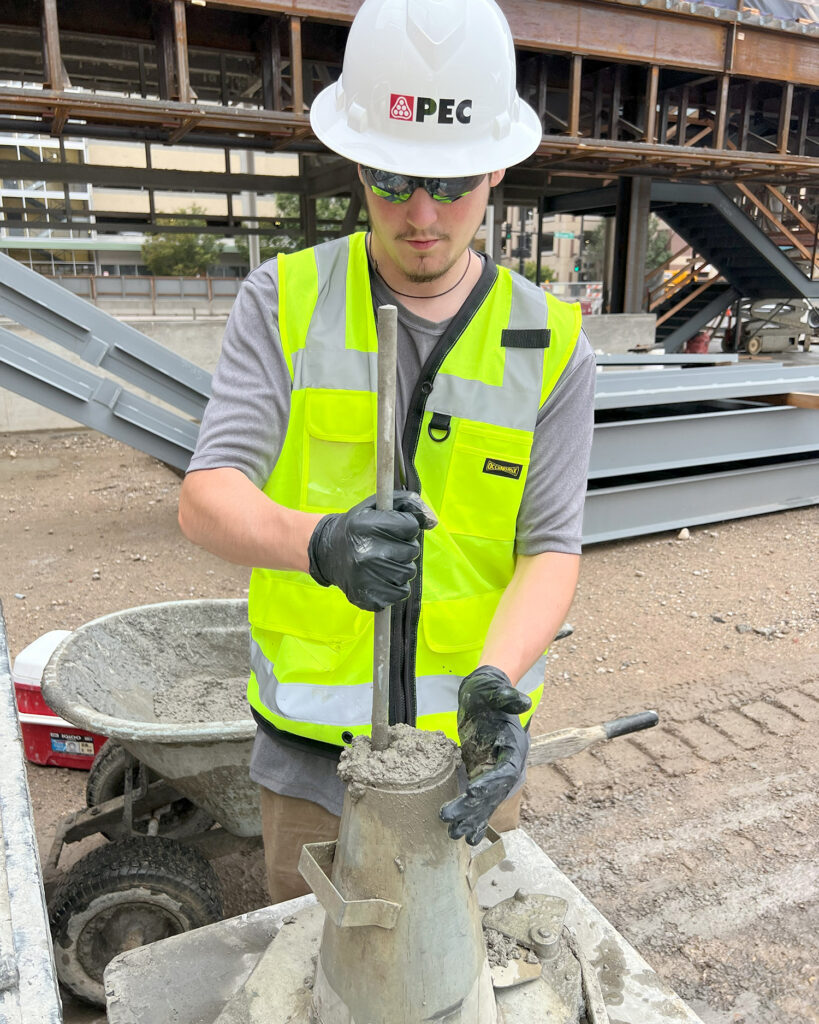
The slump test is performed within five minutes of collecting the sample to assess the concrete’s workability. Using a cone-shaped mold (12″ tall, 8″ wide at the base, 4″ at the top), the tester fills it in three equal layers, packing each layer 25 times with a rod. After filling, the mold is lifted, and the decrease in height (the slump) is measured. Each project has an acceptable slump range so the mix is neither too wet nor too dry.
Air Test
Air content is crucial, especially for concrete exposed to freeze-thaw cycles. The air test, conducted within 15 minutes of sampling, follows a similar layering and tamping process. After filing, the mold is struck with a mallet to eliminate air pockets, leveled, and weighted. The device is then pressurized, and after stabilization, the air-void reading is taken. This allows the concrete to expand and contract as needed without cracking.
Strength and Durability Testing
To verify long-term performance, five sample cylinders are prepared. Two cylinders are tested after seven days of curing, two more after 28 days, and one serves as a backup. These samples are transferred to the curing room, where they can be held in the proper conditions for the required amount of time. Then, they undergo strength and durability testing in the lab.
Field Services: Partners from Start to Finish
Field services teams are typically involved at every stage of a project, from initial surveys and geotechnical assessments to materials testing and final inspections. Their expertise helps every batch of concrete meet the highest standards from the first pour to project completion.